
AMD Call for Submissions: Registered Reports
This is a permanent call for submissions for Academy of Management Discoveries.

3 December @ 9:00 – 12:00 EST
Dr. Goran Kuljanin
DePaul University
This workshop introduces participants to computational modeling. Specifically, we discuss and demonstrate the use of computational models as a tool to develop more explicit, transparent, reproducible, and insightful theories for organizational science. To do so, we begin with a discussion to distinguish the difference between narrative construct theorizing (i.e., the dominant form of theory development in organizational science) and computational process theorizing (i.e., the form of theory development promoted in the workshop). After this initial discussion, we collectively work through a specific motivated example to demonstrate how to: program a computational model using software (R, Positron, and GenAI), execute virtual experiments with a developed computational model, and analyze simulated data from a computational model to derive theoretical insights. During this collective work experience, participants actively engage in completing various tasks pertaining to process thinking, programming, simulation, and data analysis. By the end of this workshop, participants will gain an understanding of the importance of computational modeling for effective theory development and how to take the next steps in developing computational models for their own theories of interest.

Professor Goran Kuljanin serves as an Assistant Professor in the Department of Management and Entrepreneurship in the Driehaus College of Business at DePaul University. He primarily teaches courses on business and people analytics. His courses cover topics such as data visualization, analytical notebooks, unsupervised and supervised learning, natural language processing, web scraping, time series forecasting, business process analytics, and organizational network analysis.
Professor Kuljanin’s research focuses on developing computational process models of human functioning and workplace operations to enable process-oriented, strategic decision-making on human resources management. He has published his research in the Journal of Applied Psychology, Leadership Quarterly, Organizational Research Methods, and Psychological Methods. His research awards include Best Article in Organizational Research Methods in 2013, the 2015 William A. Owens Scholarly Achievement Award from the Society of Industrial and Organizational Psychology, and a Monograph Distinction from the Journal of Applied Psychology. As a co-investigator, he has won grants from the U.S. Army Research Institute for the Behavioral and Social Sciences.
Professor Kuljanin’s consulting work focuses on analyzing data on any organization’s most important resource: its people. Specifically, his consulting work involves applying advanced analytics (e.g., machine learning, dynamical modeling, organizational network analysis, natural language processing, computational process modeling) on employee, team, organizational, and client data to develop effective work strategies to meet organizational objectives.
This is a permanent call for submissions for Academy of Management Discoveries.
Are you thinking of submitting a manuscript to AMP? We have a terrific global team of engaged editors eagerly awaiting the opportunity to help develop your work.
Discoveries-through-Prose empower authors to craft their manuscripts in nontraditional ways that make for tighter, more engaging narratives.
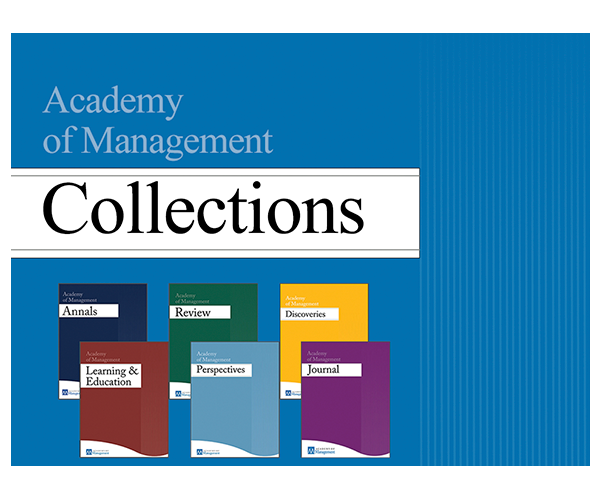
Interested in publishing an Academy of Management Collection? Submit an original essay tied to articles selected from the AOM archive.
Actionable Solutions to Real-World Problems of Practice and Policy Based on Prior Academy of Management Publications
For this special issue, we invite submissions to all of AMLE’s peer-reviewed sections, including Research and Reviews, Essays, and Book and Resource Reviews.
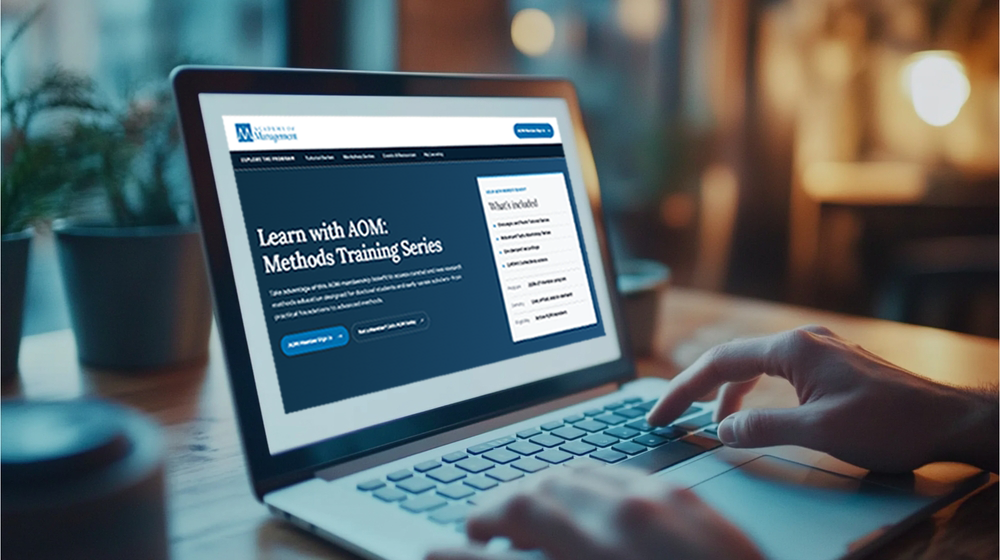
This lecture will discuss basic and advanced multilevel analyses, using random coefficient modeling (RCM) in R. The lecture will start by laying out a foundation for analyzing two-level models in RCM, where the dependent variable is at the lower level (Level 1), and predictors are at both the lower level (Level 1) and a higher-level unit (Level 2).
This summit, hosted by the Academy of Management’s Community Accelerator Program and the Western Michigan University College of Education and Human Development, brings together academics and industry professionals to explore the intersections of theory and application and how each domain is strengthened by the other.
The webinar is designed for academics, doctoral researchers, early-career scholars, and established researchers interested in strengthening their connections with the Academy of Management and contributing to the development of an inclusive, collaborative, and internationally connected management scholarship community in the Middle East.

This idea development workshop (IDW) is primarily geared toward early career researchers (e.g., assistant professors and postdoctoral fellows) and PhD students who are interested in publishing in AMR—the highest-ranked journal publishing conceptual and theoretical manuscripts.
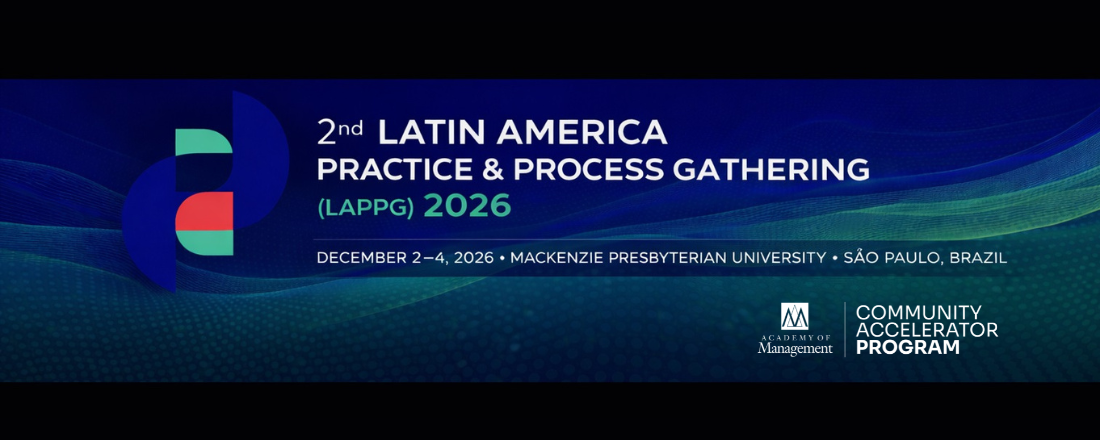
LAPPG 2026 aims to consolidate and expand a vibrant research community by bringing together senior scholars, early-career researchers, and doctoral students from across Latin America and beyond.

The conference theme is Strategic Management of High-Impact Ventures and Ecosystems in Latin America. SMLA 2026 examines the reciprocal relationship between Strategic Management principles and the institutional architectures underpinning Latin American entrepreneurial ecosystems.