
AMD Call for Submissions: Registered Reports
This is a permanent call for submissions for Academy of Management Discoveries.

23 February 2027 @ 9:00 – 12:00 EST
Dr. Michael Withers
University of Notre Dame
Organizational researchers often seek to draw causal inferences from observational data. However, this is a challenging task, given that the relevant counterfactual outcomes are by definition unobservable. Observational settings can also involve confounding that further complicates causal inference. To address these issues, a number of methodological approaches have emerged, each with its own set of identifying assumptions. Some approaches adjust for observed differences between units, while others leverage temporal variation, discontinuities, instrumental variables, or other features of the research setting to identify causal effects. Despite the benefits they provide, these approaches support a causal interpretation only when their underlying assumptions hold. Although researchers can often evaluate the plausibility of these assumptions and test some of their observable implications, the identifying assumptions themselves generally cannot be established from the observed data alone. As such, applying these approaches requires careful consideration and evaluation. In this session, we focus on the assumptions that make causal inference possible and on the ways those same assumptions constrain it.

Michael C. Withers is a professor in the Department of Management & Organization at the University of Notre Dame’s Mendoza College of Business. He received his Ph.D. in strategic management from the W. P. Carey School of Business at Arizona State University. His research focuses on how organizations manage external dependencies and adapt to changing competitive environments through strategic decision-making, executive leadership transitions, and corporate governance mechanisms. His work has appeared in leading journals, including Academy of Management Journal, Academy of Management Review, Strategic Management Journal, Organization Science, Journal of Management, and Journal of Applied Psychology. He is a Senior Editor of the Journal of Management and an Associate Editor of Organizational Research Methods.
This is a permanent call for submissions for Academy of Management Discoveries.
Are you thinking of submitting a manuscript to AMP? We have a terrific global team of engaged editors eagerly awaiting the opportunity to help develop your work.
Discoveries-through-Prose empower authors to craft their manuscripts in nontraditional ways that make for tighter, more engaging narratives.
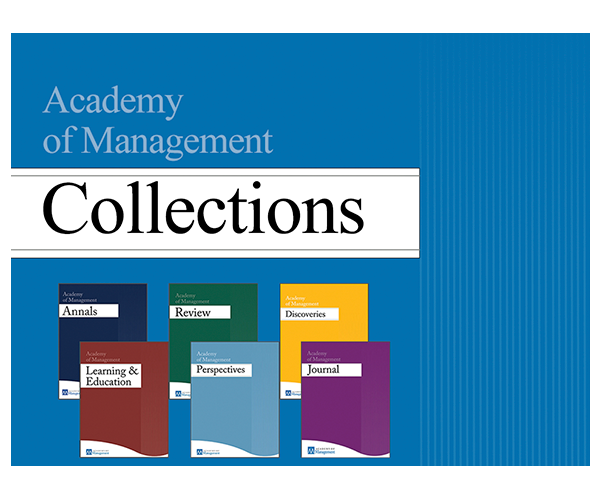
Interested in publishing an Academy of Management Collection? Submit an original essay tied to articles selected from the AOM archive.
Actionable Solutions to Real-World Problems of Practice and Policy Based on Prior Academy of Management Publications
For this special issue, we invite submissions to all of AMLE’s peer-reviewed sections, including Research and Reviews, Essays, and Book and Resource Reviews.
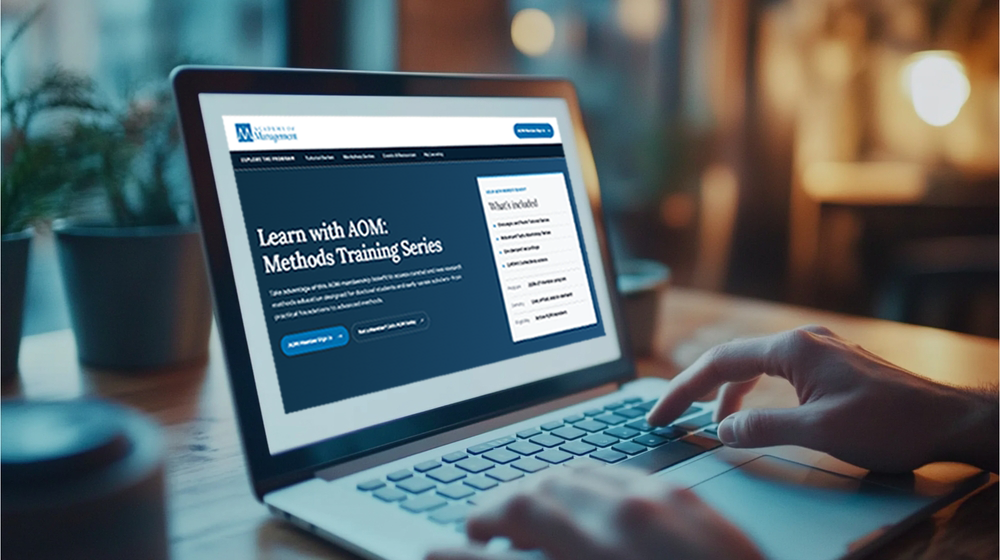
This lecture will discuss basic and advanced multilevel analyses, using random coefficient modeling (RCM) in R. The lecture will start by laying out a foundation for analyzing two-level models in RCM, where the dependent variable is at the lower level (Level 1), and predictors are at both the lower level (Level 1) and a higher-level unit (Level 2).
This summit, hosted by the Academy of Management’s Community Accelerator Program and the Western Michigan University College of Education and Human Development, brings together academics and industry professionals to explore the intersections of theory and application and how each domain is strengthened by the other.

The webinar is designed for academics, doctoral researchers, early-career scholars, and established researchers interested in strengthening their connections with the Academy of Management and contributing to the development of an inclusive, collaborative, and internationally connected management scholarship community in the Middle East.

This idea development workshop (IDW) is primarily geared toward early career researchers (e.g., assistant professors and postdoctoral fellows) and PhD students who are interested in publishing in AMR—the highest-ranked journal publishing conceptual and theoretical manuscripts.
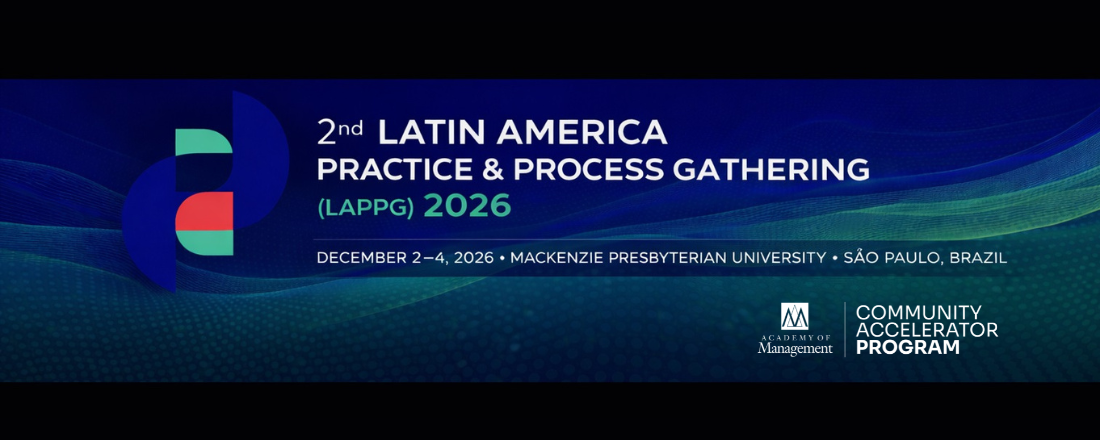
LAPPG 2026 aims to consolidate and expand a vibrant research community by bringing together senior scholars, early-career researchers, and doctoral students from across Latin America and beyond.

The conference theme is Strategic Management of High-Impact Ventures and Ecosystems in Latin America. SMLA 2026 examines the reciprocal relationship between Strategic Management principles and the institutional architectures underpinning Latin American entrepreneurial ecosystems.