
AMD Call for Submissions: Registered Reports
This is a permanent call for submissions for Academy of Management Discoveries.

19 November 2026 @ 0:00 – 12 January 2027 @ 5:00 EST
The Management History (MH) Division invites symposium and paper submissions for the 87th Annual Meeting of the Academy of Management to be held in Vienna, Austria, 30 July to 3 August 2027. The Submission Center will open early in December and have a submission deadline of Tuesday, 12 January 2027, at 17:00 ET (22.00 GMT).
The Management, Spirituality and Religion (MSR) Division warmly invites scholarly submissions for the 87th Annual Meeting of the Academy of Management (AOM 2027) in Vienna, Austria, from 30 July to 3 August 2027. Given the cross-disciplinary and global nature of our mission, we welcome submissions that span domains, scholarly fields, traditions of knowing and research methods.
Vienna has long been a crossroads of East and West, of empires and of ideas. It is a fitting place to ask how we discern well in a world of many voices, powers and worldviews, and in which artificial intelligence is entering the very spaces where judgement, meaning and conscience live.
All submissions are made through the new AOM Submission Center.
See the AOM submission guidelines.
We live in a polycrisis of entangled ecological, geopolitical, social and technological crises. Power, knowledge and voice are now spread across many centres, cultures and worldviews. Yet we often still look at this world through a linear, either–or lens. When that happens, we encroach on each other’s spaces: markets move into universities, algorithms into our attention, and groups into each other’s worldviews.
Artificial intelligence sharpens this question. It can free people from mindless work, but it can also make organizing itself mindless. How much human and how much AI do we need? What can we delegate, and what calls for human discernment? Spiritual and religious traditions offer rich resources here: practices of discernment, conscience and attunement, and the idea of an inner, unencroachable space from which peace, coherence and wise action can arise. Discernment is the capacity that connects inner life to outer impact: it helps us sense what to hold, what to delegate, and what to protect when AI enters our work.
We invite contributions that explore three interrelated lenses:
In line with MSR’s research agenda, we organise these questions along the four core domains of spirituality in management: ontology, epistemology, axiology and praxeology. Foundational work in these domains is a distinctive contribution of MSR within the Academy, and we warmly invite it.
Ontology: what is the human, the self and the sacred?
Epistemology: how do we know?
Axiology: what do we value, and for whom?
Praxeology: how do we act and organize?
Teaching
These questions are not exhaustive. MSR welcomes all submissions within its domain, including those that do not address the theme. The three AOM session orientations fit MSR’s Core–Outreach–Teaching approach: Research for core work, Research Impact on Practice for outreach, and Teaching for pedagogy.
Paper submissions. One or more authors submit an academic paper. Accepted papers are grouped by the Program Chair into themed paper sessions.
Presenter symposia. A series of authored papers that the submitter organizes around a theme of their choosing.
Panel symposia. A group of panelists in an interactive discussion. Proposals should describe the topic and how the discussion among panelists and with the audience will be facilitated.
Poster sessions. A less formal way to share work, in one-hour in-person poster sessions in a highly visible location at the Annual Meeting. Poster submissions are extended abstracts of up to 1,750 words and are exempt from the rule of three.
When submitting a paper, authors may now name a secondary DIG as co-sponsor. We encourage this to build bridges between MSR and other divisions.
Based on reviewer feedback, the Program Chair selects:
AI tools offered by AOM may support parts of the process. All acceptance and award decisions in MSR are made by people.
The 2027 MSR PDW Call shares this theme. Scholarly sessions focus on research and theory; PDWs offer developmental and experiential formats. We encourage authors to connect their work across both programs.
Management, Spirituality, and Religion is a community engaged in interdisciplinary theoretical and applied research and pedagogy related to the relevance and relationship of spirituality and religion in management. MSR explores how spirituality and religion influence organizational dynamics and affect management outcomes. MSR research has made important contributions to better understand the meaning of work, the impact of spirituality and spiritual leadership in the workplace, the purpose of business, the effects of religious pluralism in the workplace, and the distinctive elements of individual religious and spiritual beliefs that cultivate inner awareness and promote wellness and wisdom for the common good.
Prof. dr. Sharda S. Nandram, MSR Division Program Chair, AOM 2027: dedicated MSR program e-mail [email protected].
We look forward to your submissions and to meeting you in Vienna.
This is a permanent call for submissions for Academy of Management Discoveries.
Are you thinking of submitting a manuscript to AMP? We have a terrific global team of engaged editors eagerly awaiting the opportunity to help develop your work.
Discoveries-through-Prose empower authors to craft their manuscripts in nontraditional ways that make for tighter, more engaging narratives.
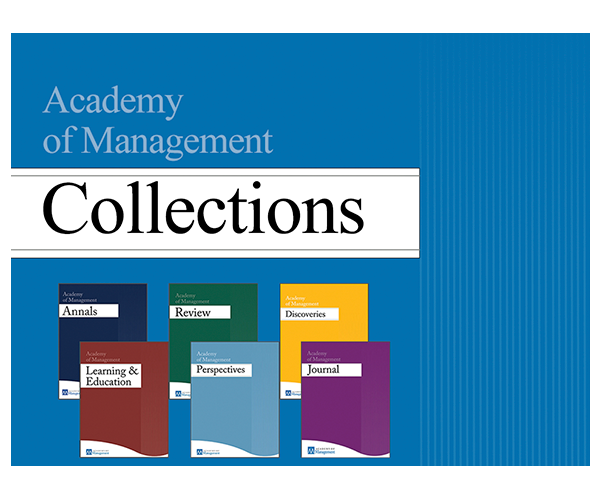
Interested in publishing an Academy of Management Collection? Submit an original essay tied to articles selected from the AOM archive.
Actionable Solutions to Real-World Problems of Practice and Policy Based on Prior Academy of Management Publications
For this special issue, we invite submissions to all of AMLE’s peer-reviewed sections, including Research and Reviews, Essays, and Book and Resource Reviews.
AOM 2027 Professional Development Workshops: Call for Submissions
AOM 2027 Scholarly Program: Call for Submissions

AOM 2027 Scholarly Program: Call for Submissions Division Program Chair: Susanne Beck, Warwick Business School The 87th Annual Meeting of the Academy of Management (AOM 2027) will be held in […]

AOM 2027 Scholarly Program: Call for Submissions

AOM 2027 Scholarly Program: Call for Submissions
AOM 2027 Scholarly Program: Call for Submissions