
AMD Call for Submissions: Registered Reports
This is a permanent call for submissions for Academy of Management Discoveries.

19 November 2026 @ 0:00 – 12 January 2027 @ 5:00 EST
The AOM Sport and Management community (SPM) invites submissions for the scholarly program of the 87th Annual Meeting of the Academy of Management (AOM 2027), which will take place in Vienna, Austria from Friday, 30 July through Tuesday, 3 August 2027. Scholarly paper sessions and poster presentations will take place Sunday, 1 August through Tuesday, 3 August 2027. The Submission Center opens early December 2026, and the submission deadline is Tuesday, 12 January 2027 at 17:00 ET (UTC-5/GMT-5).
The AOM Sport and Management Community initially launched at the 85th Annual Meeting of the Academy of Management (AOM) in Copenhagen. The community brings together management scholars using sport data for advancing management theory and sport management scholars advancing sport management research. Given the substantial role of sport in society, economy and politics, we encourage impactful scholarship that addresses challenges relevant for sport organizations and scholarship that addresses general management challenges using sport as a context or using sport data.
Sport is, indeed, at once a context (both generalizable and also unique), a data source, and an object of study. We invite submissions in two broad and overlapping domains, and especially welcome work at their intersection. Theoretical, empirical, qualitative, quantitative, computational, and methodological contributions are all welcome.
This domain welcomes work that uses sport, its settings, its people, and its unusually rich and transparent data to develop, extend, test, or challenge management theory. Sport offers observable performance, clear rules and competitive structures, and granular longitudinal records of individuals, teams, and organizations, and we encourage scholars across all AOM divisions to ask what t study through sport can reveal about their own questions.
Leadership, teams, and human capital. How leaders, coaches, and captains emerge and shape motivation, resilience, and team dynamics; talent identification, star performers, team composition and diversity, succession, careers and transitions; and what sport experience contributes to leadership development in organizations more broadly.
Strategy, competition, and coopetition. How tactics and strategies from the field transfer to, or explain, those of non-sport organizations; competitive dynamics, rivalry, and resource allocation under constraint (salary caps, drafts, transfer windows); and the interdependence of simultaneous competition and cooperation in leagues and federations, and what it teaches us about alliances, ecosystems, and interorganizational relationships.
Organizations and institutions. Sport organizations sit at the intersection of commercial, community, political, and cultural logics, making them fertile ground for research on institutional complexity, hybrid organizing, legitimacy, identity, culture, and the diffusion of practices across clubs, leagues, and countries.
Innovation, technology, and data. Sport is an early adopter and accelerator of new technology, from performance analytics and wearables to video-assisted officiating and generative and predictive AI. We invite research on how innovations are introduced, resisted, and diffused, and on how decision-making, expertise, and evaluation change when algorithms enter the coaching room, the boardroom, and the referee’s booth.
Behavior and methods. The visibility of individual behavior in sport enables rigorous study of decision-making, incentives, learning, fairness, and misconduct. We also welcome methodological contributions: natural experiments from rule changes, large-scale tracking and event data, machine-learning approaches, and reflections on the external validity of sport-based findings.
This domain welcomes work that advances sport management scholarship and addresses the challenges facing clubs, leagues, federations, governing bodies, event organizers, grassroots sport, and the growing ecosystem of media, technology, and betting firms around them.
Governance, ownership, and accountability. How leagues, clubs, and governing bodies balance commercial goals with responsibilities to athletes, fans, and communities; the consequences of ownership models (member-owned clubs, private equity and sovereign-wealth investment, multi-club groups, franchises); governance reform and integrity; and what cross-sport and cross-country comparison reveals about whose interests shape decisions.
Business models and industry transformation. The reshaping of the sport industry by streaming and media rights, direct-to-consumer platforms, the rise of women’s professional sport, new competition formats, esports, global sports betting, and the entry of global capital; and the deployment of AI and data across scouting, ticketing, fan engagement, content, and integrity monitoring, including questions of data governance and athlete data rights.
Athletes and Staff work and wellbeing. Athletes as workers in short, precarious, and highly scrutinized careers: welfare and mental health, labor relations, athlete voice and activism, safeguarding, dual and post-sport careers, and the economics and ethics of youth and college sport, including athlete compensation. Work on coaches, officials, event staff and the wider sport workforce is equally welcome.
Fans, brands, and communities. Fan identity and engagement, sponsorship and brand management, community ownership and local embeddedness, venue development, and the tensions that arise when commercialization meets tradition, place, and belonging.
Sport, society, and grand challenges. Sustainability and the climate footprint of sport and mega-events; diversity, equity, and inclusion; sport’s role in health, education, and social cohesion; geopolitics, soft power, and the use of sport by states and corporations; and human rights, corruption, and the responsibilities of sport organizations as global institutions. We also welcome research on sport entrepreneurship, sport-tech ventures, and the internationalization of sport organizations.
Across both domains, we particularly encourage submissions that build bridges between management disciplines and sport management, between rigor and practical relevance, and between scholars long engaged with sport and those approaching it for the first time.
We invite submissions addressing research questions such as:
The SPM Community also invites proposals for Professional Development Workshops. PDWs are interactive sessions designed to build skills, share practice, and foster connections among scholars at all career stages, and we welcome proposals on a wide and heterogeneous range of topics. These may include, for example, publishing sport-based research in management outlets, publishing in sport management outlets, teaching with sport (cases, data, simulations, and experiential approaches), and generating impact with sport through engagement with sport organizations, policymakers, and practitioners. We also welcome proposals on related themes, such as accessing and working with sport data, and encourage formats that bring together management and sport management scholars as well as industry professionals. PDW proposals must follow the AOM submission guidelines.
The SPM Community offers an interdisciplinary place for exchange during AOM and an online space on the AOM website after the conference throughout the year. We invite scholars from different management disciplines interested in studying the sport phenomena as context, data source or proper object of study as well as sport management scholars that are interested in engaging with management theories and mutual learning opportunities.
This is the first time that the SPM launched a call for scholarly work. Full paper and/or developmental papers, posters submissions, symposia, professional development workshop (PDW), and developmental paper workshops must follow AOM submission guidelines. Submissions will get two double-blinded peer reviews and possibly the opportunity to present as an oral presentation, developmental roundtable setting, symposia, or poster presentation during the 2027 Annual Meeting.
The AOM SPM Community plans to organize various sessions such as PDW– Using sport data for management theory development, and developmental papers session focused on advancing papers and ideas.
Lastly, the SPM Community is planning a social with local sport professionals and potential a sport venue visit.
We especially welcome both regular AOM goers that work on sport-related topics as well as AOM first-timers working on sport management-related topics. We extend the invitation to join the review board of the AOM SPM Community as well as joining the coordinating team for contributing to community activities at future AOM events.
We look forward to receiving your submissions. For any questions, please contact the scientific Program Chair, Anna Gerke.
This is a permanent call for submissions for Academy of Management Discoveries.
Are you thinking of submitting a manuscript to AMP? We have a terrific global team of engaged editors eagerly awaiting the opportunity to help develop your work.
Discoveries-through-Prose empower authors to craft their manuscripts in nontraditional ways that make for tighter, more engaging narratives.
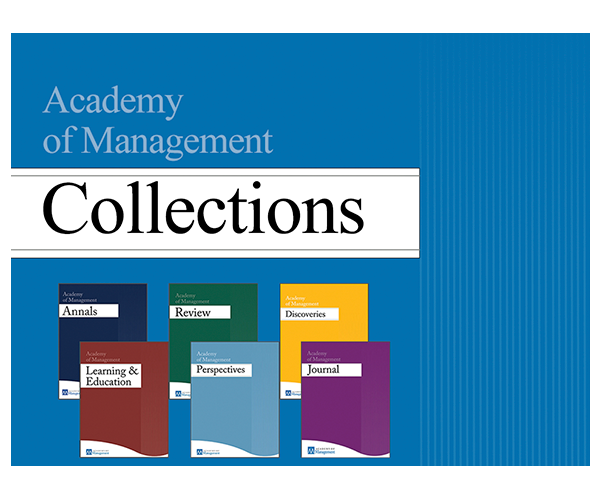
Interested in publishing an Academy of Management Collection? Submit an original essay tied to articles selected from the AOM archive.
Actionable Solutions to Real-World Problems of Practice and Policy Based on Prior Academy of Management Publications
For this special issue, we invite submissions to all of AMLE’s peer-reviewed sections, including Research and Reviews, Essays, and Book and Resource Reviews.
AOM 2027 Professional Development Workshops: Call for Submissions
AOM 2027 Scholarly Program: Call for Submissions

AOM 2027 Scholarly Program: Call for Submissions Division Program Chair: Susanne Beck, Warwick Business School The 87th Annual Meeting of the Academy of Management (AOM 2027) will be held in […]

AOM 2027 Scholarly Program: Call for Submissions

AOM 2027 Scholarly Program: Call for Submissions
AOM 2027 Scholarly Program: Call for Submissions