
AMD Call for Submissions: Registered Reports
This is a permanent call for submissions for Academy of Management Discoveries.

1 October 2025 @ 0:00 – 31 October 2025 @ 0:00 EDT
See the related Paper Development Workshop details for this Special Issue.
The COVID-19 pandemic underscored that complex problems cannot be effectively tackled by organizations acting in isolation. Collaboration between businesses, governments, and civil society organizations proved necessary. The coordinated response from pharmaceutical companies, public authorities, nonprofit organizations, and social enterprises leveraging their financial resources, expertise, and local knowledge to develop and distribute reliable and effective vaccines, was vital in saving lives worldwide. 1 This cooperation not only addressed immediate public health needs but also established a precedent for future collaborative responses to global challenges. Similarly, major technological innovations such as smartphones owe their existence to substantial public investments in basic research, the entrepreneurial spirit of private innovators, and the significant contributions of nonprofit institutions like Stanford University.2 In the same vein, coordinated actions between firms and civil society groups have proven essential in reducing deforestation and increasing community well-being while ensuring economic benefits for businesses and numerous stakeholders in underserved communities.3
Despite these success stories, management scholarship has been slow to embrace the full complexity of cross-sectoral collaborations. It frequently emphasizes free-market solutions and the business case for collaboration—such as how firms can leverage relationships with public and civil society organizations—while tending to overlook broader societal challenges. 4 In this special issue, we aim to highlight practical ways that these relationships can be reshaped to better address the evolving social, environmental, and economic challenges of our time.
We invite scholarly studies that explain how the major challenges of our time can be or have been better addressed through specific reconfigurations of the relationships between firms, governments, and civil society organizations, which include nonprofits cooperatives, associations, and social movements. We encourage both conceptual and empirical papers that are grounded in rigorous analysis and support specific and significant managerial and policy actions. In short, we want papers that show what can or does work, in ways that managers and policymakers can use.
Please note that AMP’s mission and format differ from many other leading academic journals. AMP papers are managerially driven, not theory driven. Successful submissions clearly define the managerial issue from the outset and make a compelling case for its importance. They do not simply tack managerial implications on to a standard academic study. Rather, AMP papers provide actionable insights that guide managerial behavior and influence policy decisions. We strongly encourage potential authors to review AMP’s guidelines at aom.org/amp before submission. Note that we also welcome Practitioner Perspectives essays and Constructive Confrontations papers for this special issue. Guidance for both formats is also on our website.
For this special issue, we welcome submissions of relevant, rigorous, and readable papers that address a broad range of topics, including but not limited to the following:
In an era where the intersection of business, government, and civil society has never been more critical, we encourage submissions that offer fresh perspectives and innovative solutions that managers and policymakers can implement to reshape these relationships for a more equitable and sustainable future.
The submission deadline is 31 October 2025. Papers must be submitted on the AMP website at https://mc.manuscriptcentral.com/amp.
All papers will be reviewed according to the current policies of Academy of Management Perspectives. AMP papers should be grounded in evidence or robust conceptual frameworks, address relevant real-world managerial and policy issues, offer actionable insights, avoid theory fetish, and be written in a style accessible to non-specialists and practitioners.
We intend to host a Paper Development Workshop at the 2025 AOM Conference in Copenhagen for selected authors to further develop their manuscripts. Participation in this workshop is neither a guarantee nor a prerequisite for publication. This special issue is expected to be published in 2027.
1 S. Bacq and G. Lumpkin, G. “Social Entrepreneurship and COVID‐19,” Journal of Management Studies 58, no. 1 (2021): 285; S. Cabral, Strategy for Public and Nonprofit Organizations: An Applied Perspective (London: Palgrave Macmillan, 2024).
2 M. Mazzucato The Entrepreneurial State: Debunking Public vs Private Sector Myths (New York: Anthem Press Mazzucato, 2013).
3 S. Bacq, C. Hertel, and G. Lumpkin, (2022). “Communities at the Nexus of Entrepreneurship and Societal Impact: A Cross-Disciplinary Literature Review,” Journal of Business Venturing 37, no. 5 (2022): 106231; M. L. Barnett, I. Henriques, and B. W. Husted, “Beyond Good Intentions: Designing CSR Initiatives for Greater Social Impact,” Journal of Management 46, no. 6 (2020): 937–64; A. Gatignon and L. Capron, “The Firm as an Architect of polycentric Governance: Building Open Institutional Infrastructure in Emerging Markets,” Strategic Management Journal 44, no. 1 (2023): 48–85; G. Lumpkin and S. Bacq, “Civic Wealth Creation: A New View of Stakeholder Engagement and Societal Impact,” Academy of Management Perspectives 33, no. 4 (2019): 383–404; A. M. McGahan and L. S. Pongeluppe, “There Is no Planet B: Aligning Stakeholder Interests to Preserve the Amazon Rainforest,” Management Science 69, no. 12 (2023): 7860–81.
4 S. Cabral, J. T. Mahoney, A. M. McGahan, and M. Potoski, “Value Creation and Value Appropriation in Public and Nonprofit Organizations,” Strategic Management Journal 40, no. 4 (2019): 465–75.
This is a permanent call for submissions for Academy of Management Discoveries.
Are you thinking of submitting a manuscript to AMP? We have a terrific global team of engaged editors eagerly awaiting the opportunity to help develop your work.
Discoveries-through-Prose empower authors to craft their manuscripts in nontraditional ways that make for tighter, more engaging narratives.
Interested in publishing an Academy of Management Collection? Submit an original essay tied to articles selected from the AOM archive.
Actionable Solutions to Real-World Problems of Practice and Policy Based on Prior Academy of Management Publications
For this special issue, we invite submissions to all of AMLE’s peer-reviewed sections, including Research and Reviews, Essays, and Book and Resource Reviews.
This summit, hosted by the Academy of Management’s Community Accelerator Program and the Western Michigan University College of Education and Human Development, brings together academics and industry professionals to explore the intersections of theory and application and how each domain is strengthened by the other.

This idea development workshop (IDW) is primarily geared toward early career researchers (e.g., assistant professors and postdoctoral fellows) and PhD students who are interested in publishing in AMR—the highest-ranked journal publishing conceptual and theoretical manuscripts.
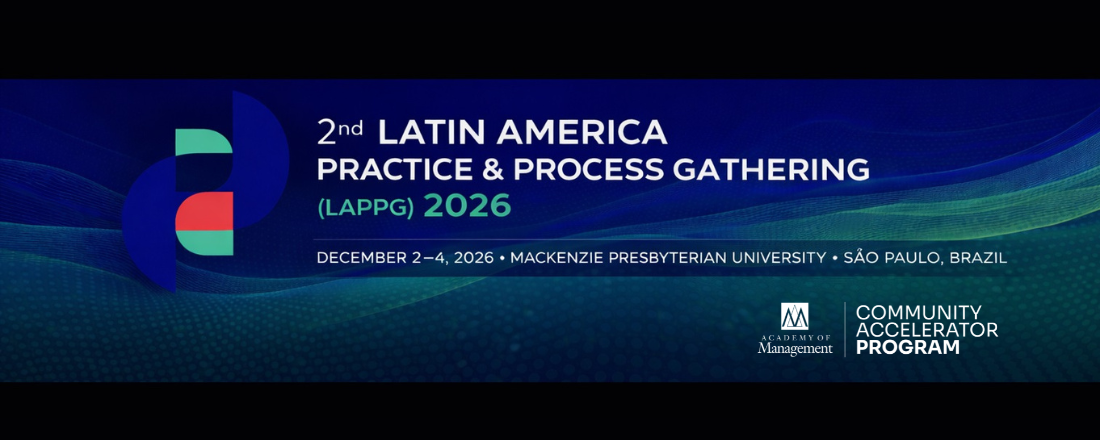
LAPPG 2026 aims to consolidate and expand a vibrant research community by bringing together senior scholars, early-career researchers, and doctoral students from across Latin America and beyond.

The conference theme is Strategic Management of High-Impact Ventures and Ecosystems in Latin America. SMLA 2026 examines the reciprocal relationship between Strategic Management principles and the institutional architectures underpinning Latin American entrepreneurial ecosystems.
By the end of this workshop, participants will gain an understanding of the importance of computational modeling for effective theory development and how to take the next steps in developing computational models for their own theories of interest.
This intensive program aims to strengthen research capabilities, build local research communities, and increase the region’s capacity to produce high-impact research.